
Why we chose the NextPM to measure particles
The particle probe is the part that matters most in an air quality sensor. For ours, we chose the NextPM, developed and manufactured in France by Tera Sensor.
The NextPM is now fitted to all our sensors except the educational kits: the NebuleAir, the NebuleAir Pro, the ModuleAir and the ModuleAir Mini. It measures PM1, PM2.5 and PM10 using an optical method.
A reliable French manufacturer
Our first criterion was the manufacturer. We wanted to work with a reliable French company that develops and manufactures its own probe.
Tera Sensor is part of Groupe TERA, which has worked on air quality measurement for more than twenty years. The probe's laser, fan and heating are designed in-house, and the design is protected by three patents. Each batch is checked by sampling in their laboratory in Rousset, where the PM2.5 calibration is verified with an aerosol of 0.1 to 10 µm particles.
How the probe works
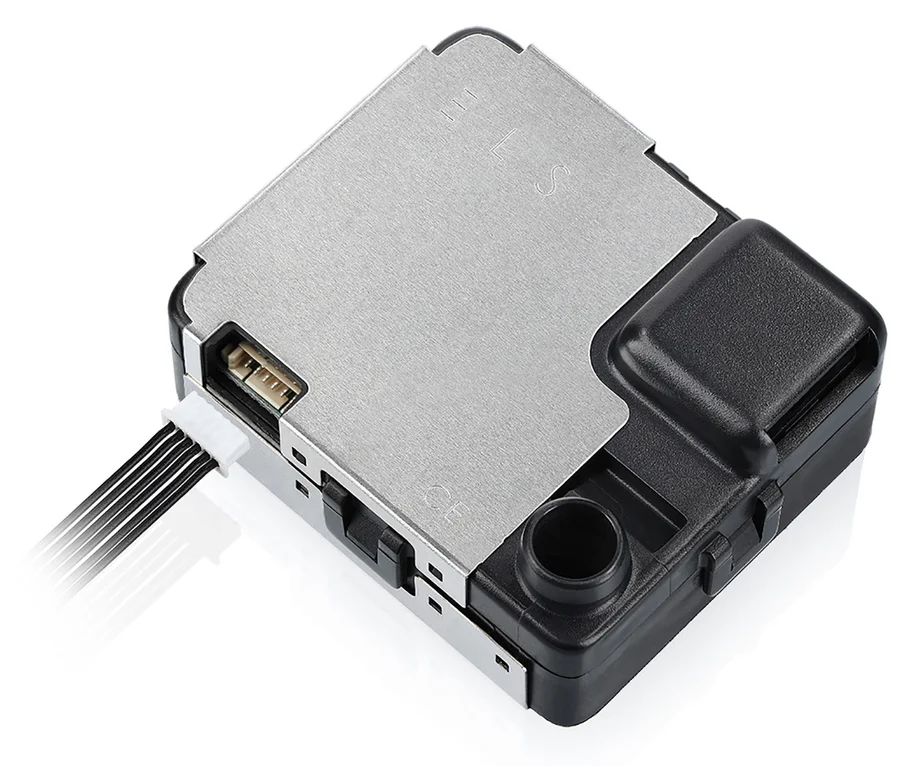
- Two measurement angles. A laser lights the sampled air and two photodetectors measure the light scattered by particles, at 45° and 90°. Tera Sensor describes this dual angle as unique in this category of sensors: according to the manufacturer, the 90° angle alone cannot properly tell apart particles of 1 to 5 µm.
- An air inlet that sorts particles. Its shape keeps out particles larger than 10 µm, with no filter to replace. A tray collects the dust: according to the manufacturer, it is enough for ten years of continuous measurement at 150 µg/m³.
- Little fouling. In the laboratory, Tera Sensor passed 0.5 g of particles through the probe. The photodetectors were not fouled, and the readings had drifted by less than 20%.
These details come from the NextPM technical introduction published by Tera Sensor.
What independent evaluations say
The AQ-SPEC programme in California evaluated the NextPM in the laboratory and in the field in 2021. In the field, the three probes tested tracked the reference instruments well for PM1 (R² of 0.89 to 0.95) and PM2.5 (R² of 0.88 to 0.95). The evaluation summary is public.
In Marseille, AtmoSud and Aix-Marseille University also studied the probe at the instrumented Longchamp site. According to the summary published by Tera Sensor, two weeks of daily means compared with a certified analyser give a correlation coefficient above 0.95 for PM1, PM2.5 and PM10.
Six months next to a reference station
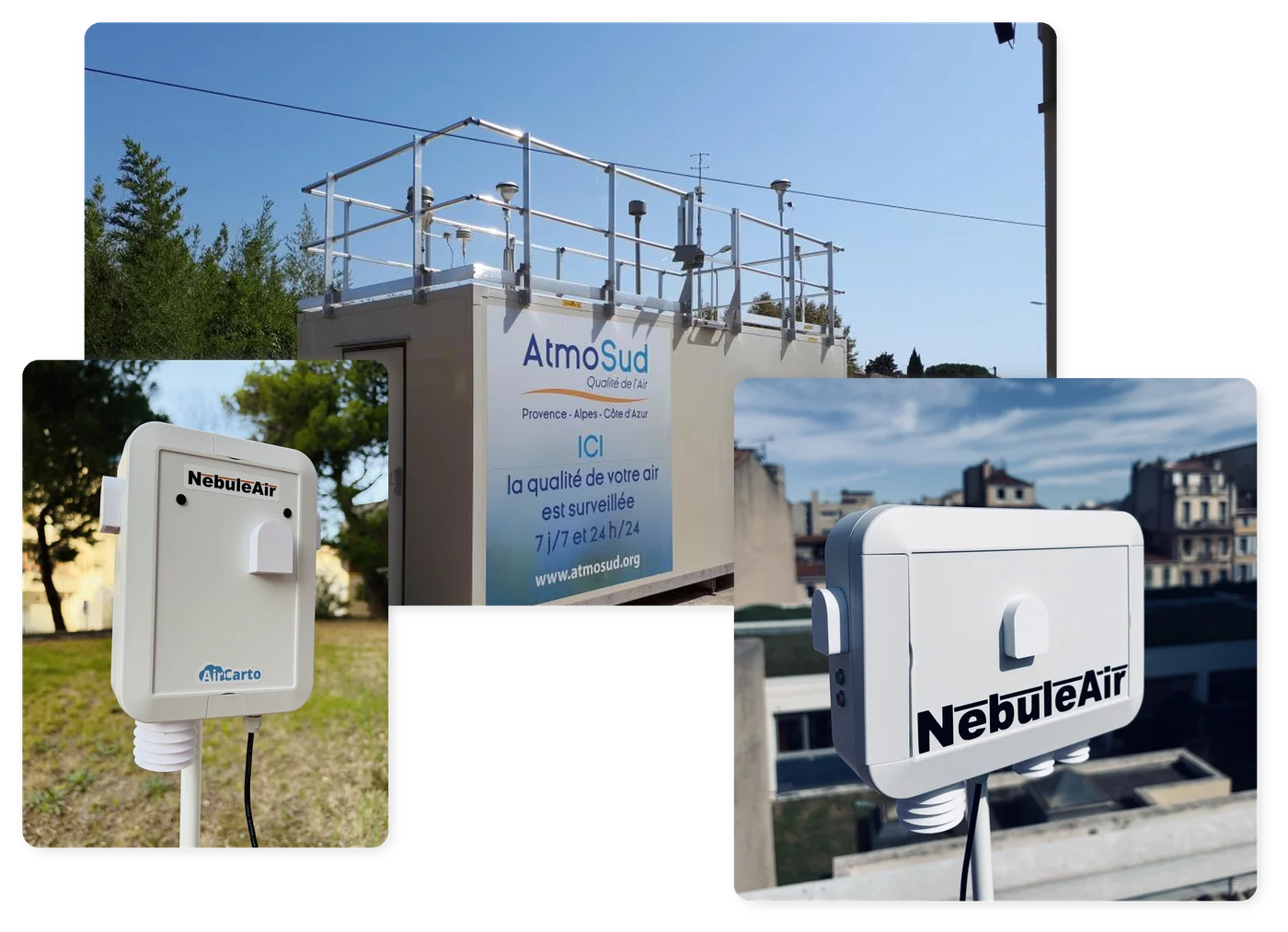
A probe is not judged on its datasheet but next to a reference instrument. Since May 2026, ten NebuleAir Pro sensors fitted with the NextPM have been running at AtmoSud's Marseille-Longchamp station, next to a Fidas, the particle monitor AtmoSud uses at this site. We compared their PM2.5 readings with the hourly data published by AtmoSud, from 22 May to 17 November 2026.
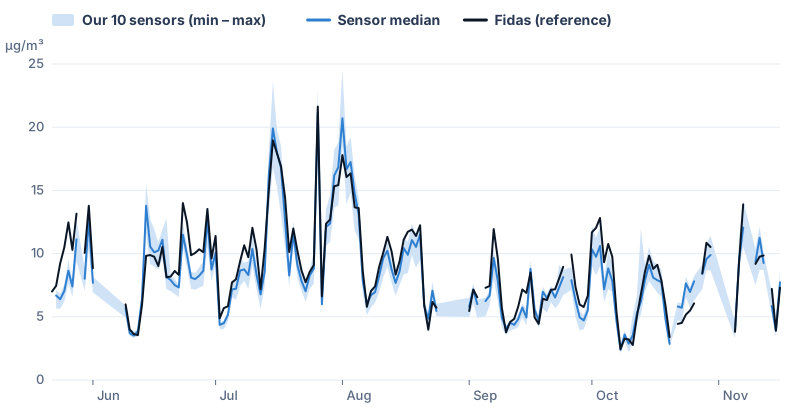
daily R² against the Fidas, depending on the sensor
average offset from the Fidas, uncorrected
daily standard deviation between the 10 sensors
daily mean absolute error of sensor pro059, before and after correction
1. Reliable readings, even uncorrected
- The sensors track the reference. On daily means, R² ranges from 0.83 to 0.90 depending on the sensor. On hourly data it is 0.57 to 0.69: hour to hour the readings are noisier, but the trends are the same.
- The average offset is small. The sensors read 0.6 µg/m³ low on average, for daily levels of 2.5 to 22 µg/m³ over the period. On daily means, the mean absolute error is about 1.1 µg/m³.
- The sensors agree with each other. Over a day, the standard deviation between the ten sensors is 0.6 µg/m³ (median).
The comparison also shows when a sensor drifts. Over the period, it revealed that one sensor returned aberrant values from June onwards, and that two others departed from the reference for a few weeks. Those periods are excluded from the figures above.
2. A correction specific to each sensor
Each probe has a slight bias of its own. Sensor pro059, for instance, read 1.7 µg/m³ low on average, more than the others. To correct it, we computed a factor from its first four weeks next to the Fidas (22 May to 21 June), then applied it to the following five months without recalculating it.
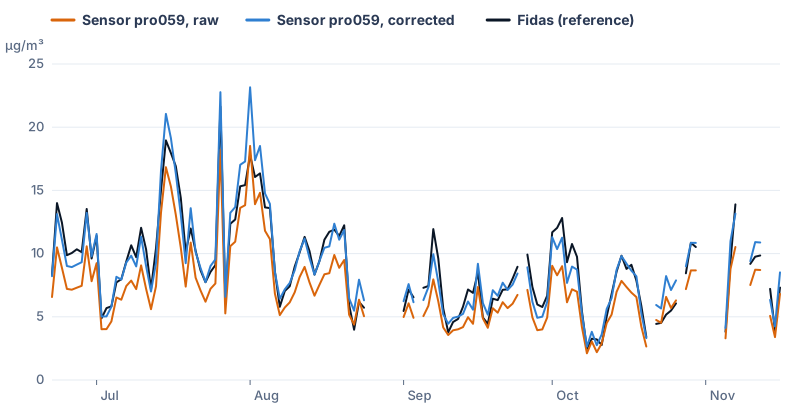
Over those five months, pro059's average offset goes from −1.7 to +0.2 µg/m³, and its daily mean absolute error from 1.8 to 0.9 µg/m³. Applied to all ten sensors, the same method narrows the spread between them from 0.6 to 0.4 µg/m³.
The correction only helps sensors with a clear bias: for those already close to the Fidas, it brings no improvement. The factor also varies somewhat with the seasons. That is why we prefer to recalibrate sensors regularly against a reference station rather than apply a fixed factor once and for all.
The limits
The NextPM is not a reference instrument. The same AQ-SPEC evaluation shows a markedly weaker correlation for PM10 in real conditions (R² of 0.35 to 0.68). This is a limit shared by optical sensors in this category, and we tell our customers about it.
Humidity is the other limit of these sensors. According to Tera Sensor, above 65% relative humidity, and especially above 80%, particles absorb water and grow, and an optical sensor then overestimates their mass. The NextPM heats the air at its inlet to keep the humidity inside the probe below 60%. At Longchamp, when the humidity measured inside our sensors exceeds 90%, their PM2.5 readings stay close to the Fidas: 3% lower on average.